Introduction
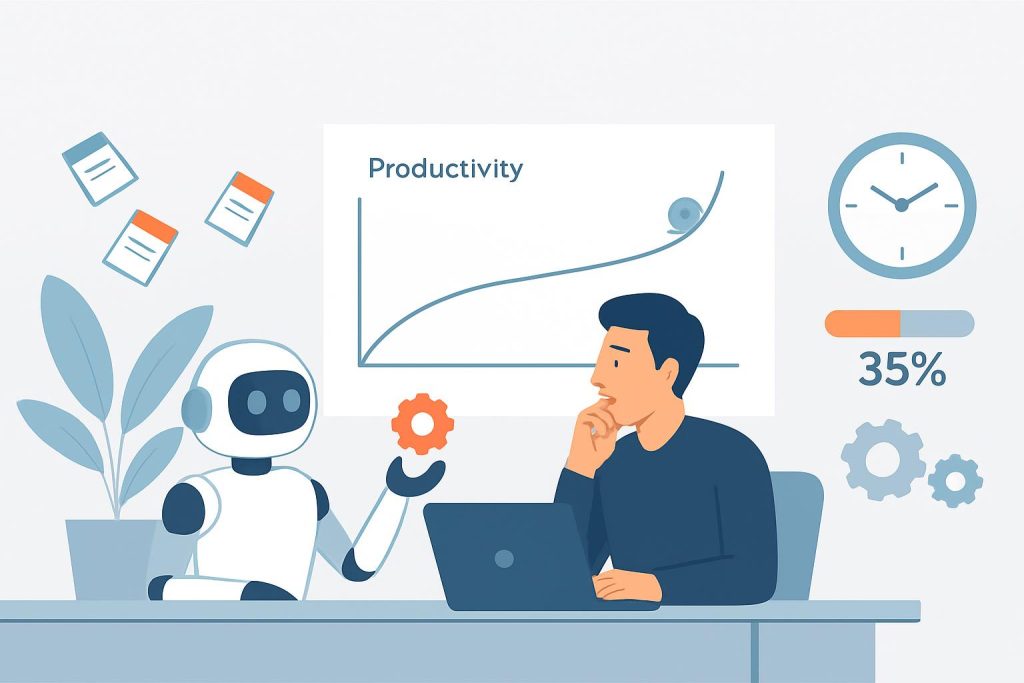
- Since 2023–25, firms worldwide ramped capital expenditure (capex) into AI hardware, software, and related automation. Expectations rose that these investments would quickly lift productivity, raise output per worker, and justify high equity valuations. But structural and transitional frictions mean large productivity gains are not guaranteed. This article explains why gains might be slower than expected, the channels and consequences, and what firms and policymakers can do about it.
Why expectations are high
- Direct potential: AI can automate routine cognitive tasks, speed decision-making, improve R&D, and enable new products and services.
- Complementary investment: Spending on chips, data centers, cloud, sensors, and enterprise software is visible and large — signaling a long-term productivity shift.
- Market narratives: Equity markets and analysts priced a significant portion of future growth into valuations, amplifying expectations of fast payoff.
Why productivity gains may disappoint (mechanisms)
- Diffusion and adoption lags
- Adoption curve: New technologies require time to diffuse beyond frontier firms. Many firms lack the organizational capacity, digital infrastructure, or data maturity to deploy AI effectively.
- Integration complexity: AI often needs close integration with legacy IT, business processes, and human workflows — a slow, bespoke effort rather than plug-and-play.
- Skills and labor reallocation constraints
- Skills gap: High demand for data scientists, prompt engineers, ML ops, and systems integrators outstrips supply. Retraining existing workers takes time and investment.
- Reallocation frictions: Productivity gains require workers to shift into higher-value tasks; frictions (geographic immobility, sectoral mismatches, hiring frictions) slow this reallocation and can raise structural unemployment in the short term.
- Measurement issues and misattribution
- Measurement lags: Official productivity statistics (TFP, labor productivity) are published with delays and may undercount quality improvements or free digital services.
- Misattribution: Gains in output may show up as price declines or quality improvements rather than measured GDP, understating productivity impact.
- Complementary capital shortages and scaling limits
- Hardware bottlenecks: Chip shortages, supply constraints for specialized accelerators, and data-center build-out limits can throttle AI deployment.
- Capital misallocation: Firms may overinvest in headline AI projects (e.g., pilot models) without funding the complementary process changes, leading to low returns.
- Regulatory, legal, and trust barriers
- Compliance costs: Data protection, safety, and liability rules can slow deployment or require costly safeguards.
- Trust and adoption: Customers and employees may be slow to accept AI-driven decisions, limiting firms’ ability to automate or streamline services.
- Diminishing marginal returns and hype cycles
- Frontier saturation: Early adopters may reap the largest gains; later adopters face diminishing returns and higher costs.
- Hype then correction: Rapid investment driven by expectations can produce a correction when returns fall short, reducing near-term capex.
- Strategic and organizational obstacles
- Management capability: Firms need strong change management, process redesign, and governance to translate models into routine value.
- Coordination failures: Large-scale productivity gains often require coordinated investments across firms and sectors (e.g., standards, data sharing). Absent that, gains remain localized.
Macroeconomic transmission pathways if productivity gains are slow
- Investment–growth feedback: Disappointing returns on AI capex reduce future investment and lower demand for capital goods suppliers (servers, semiconductors).
- Labor market effects: Persistent reallocation frictions can keep structural unemployment and wage pressure in some sectors, contributing to sticky services inflation.
- Asset prices and financial stability: Equity valuations that priced rapid productivity improvements could correct, raising borrowing costs and reducing household wealth, which in turn dampens consumption.
- Fiscal implications: Governments that expected higher future tax revenue from productivity gains may face larger deficits if growth underperforms.
Sectoral winners and losers under slower diffusion
- Winners: Large frontier firms with in-house capabilities (tech giants, advanced manufacturers) likely still gain, widening productivity gaps.
- Losers: Small and medium enterprises (SMEs), labor-intensive service firms (hospitality, personal care), and regions with weaker digital infrastructure may lag further.
Historical analogies and lessons
- Past technology waves (IT in the 1980s–2000s, automation in manufacturing) showed long lags between investment and measurable productivity increases. Gains often required complementary organizational changes, new business models, and broad-based skill upgrades.
Policy and business responses to avoid or mitigate slow gains
- Invest in human capital: Scale training, apprenticeships, and targeted reskilling programs for AI-relevant skills; subsidize transitions for displaced workers.
- Support diffusion: Promote SME access to shared cloud, model-as-a-service platforms, and local data infrastructure; encourage standards and open tools to lower adoption costs.
- Encourage complementary investment: Co-finance digital transformation projects that pair model deployment with process redesign and change management.
- Strengthen supply chains: Address bottlenecks in semiconductors, power, and data-center capacity through strategic investments and trade cooperation.
- Smart regulation: Create predictable, proportionate rules that protect privacy and safety but avoid excessive compliance costs that stifle deployment; use regulatory sandboxes.
- Measure better: Improve national statistics to capture digital quality improvements and broader measures of well-being tied to productivity.
- Foster public–private partnerships: Share data, build common infrastructure (e.g., public datasets for health, transport), and coordinate standards to increase network effects.
Scenarios and economic impacts (concise)
- Base case (slow diffusion but steady): Productivity lifts occur over a decade; growth modestly higher than pre-AI trends but below initial market expectations; labour markets adjust gradually.
- Downside (disappointment & re-pricing): Heavy investment with low returns leads to asset price corrections, weaker capex, and below-trend growth for several years; short-term unemployment spikes in affected sectors.
- Upside (rapid, inclusive diffusion): Faster retraining and SME adoption plus resolved supply constraints deliver strong productivity growth, higher labor income over time, and robust GDP gains.
Conclusion
- While AI and related capex have transformative potential, realizing broad, fast productivity gains is not automatic. Time-consuming diffusion, skills and organizational frictions, hardware constraints, regulatory limits, and measurement issues can slow impact. Proactive policies and firm-level strategies that focus on complementary investments, workforce transitions, and diffusion support are essential to turn headline AI spending into durable productivity and inclusive growth.